

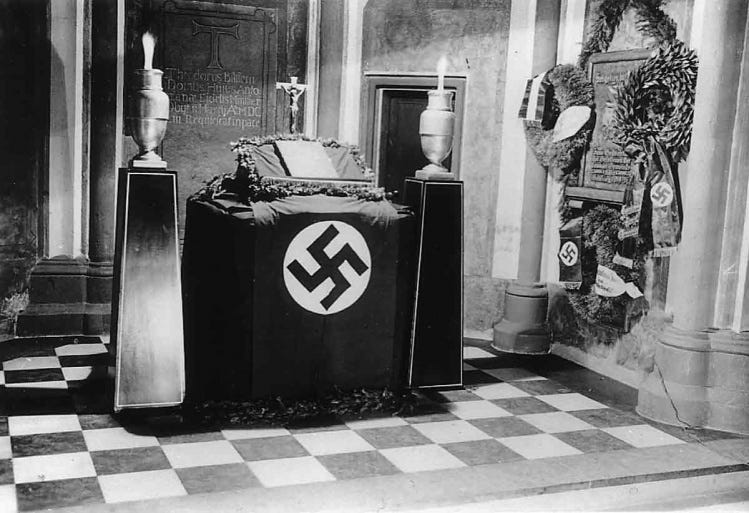
Dear friends and supporters:
Jesus Christ was a Jew. All his apostles were Jews. All the earliest Christians were Jews. They all worshiped at the temple and frequented the synagogue. They all observed the Jewish feasts and festivals. The first church was a Jewish church. Jews wrote the overwhelming majority of the Bible – including the NT. The gospel was commissioned to go first to the Jews.
Because the Bible (and by no means only the NT) contains a number of harsh criticisms of Jews (e.g., “they [Jews] always fill up the measure of their sins. But [God’s] wrath has come upon them to the utmost,” 1 Thes. 2:16), many Christians over the centuries have gotten the impression that Jewishness as a race or ethnicity is somehow inherently anti-Christian. This view is palpably mistaken. It’s true Jesus prophesied many of his Jewish listeners would persist in rejecting him, and the gospel would be expanded to the Gentiles (Mt. 21:33–46; 22:1–14; 23:34–39; Jn. 1:9–11; 8:34–44). Hovering ominously over the NT is the prophecy and prospect of the destruction of Jerusalem and the temple and the Jewish nation in A.D. 70 (Mt. 21:42–46; Mk. 12:1–12). In Paul’s missionary travels, Christ-denying Jews ceaselessly harassed him. Finally, at Corinth, he turned away from the Jews as such (Ac. 18:5–6) and devoted himself almost exclusively to Gentile evangelism and edification. To early Gentile churches in what is now western Turkey, the apostle John warned of the Jews and their malign influence (Rev. 2:9; 3:9). There can be no doubt that many, and toward end a majority of, Jews were hostile to our Lord Jesus Christ (Jn. 18:31–33).
The (Jewish) Goal of the Cross
None of this means Christianity abandoned its founding Jewishness. All to the contrary. The course of God’s covenant plan was to expand ancient godly Jewishness to include the Gentiles. Paul writes in Ephesians 2:11-19a
Therefore remember that formerly you, the Gentiles in the flesh, who are called “Uncircumcision” by the so-called “Circumcision [Jews],” which is performed in the flesh by human hands — remember that you were at that time separate from Christ, excluded from the commonwealth of Israel, and strangers to the covenants of promise, having no hope and without God in the world. But now in Christ Jesus you who formerly were far off have been brought near by the blood of Christ…. So then you are no longer strangers and aliens, but you are fellow citizens with the saints ….
One big goal of the cross was the inclusion of converted Gentiles as God’s single covenant body in Christ. The cross was the most “inclusionary” act in history. God initially limited his elective purposes to a single undeserving but beloved people. No doubt one reason he did this was to display his sovereign grace — he chooses and saves whom he will, apart from human merit, works, or achievement (Eph. 2:8–10; cf. Dt. 7:7–9). But his purpose all along was to stretch his elective purposes to all nations and peoples. Paul declares in Galatians 3:16–18,
Now the [covenant] promises were spoken to Abraham and to his seed. He does not say, “And to seeds,” as one would in referring to many, but rather as in referring to one, “And to your seed,” that is, Christ. What I am saying is this: the [Mosaic] Law, which came 430 years later, does not invalidate a covenant [Abrahamic] previously ratified by God, so as to nullify the promise. For if the [covenant] inheritance is based on law, it is no longer based on a promise; but God has granted it to Abraham by means of a promise.
The Mosaic law given to Israel was subsequent to the Abrahamic covenant (law is always subsequent to covenant) on account of man’s sin (v. 19), and the Abrahamic covenant was given before the law so that the blessing of justification by faith would enrich the world, not just the Jews. Paul argues this very point in Romans 4:16–17,
For this reason it [justification] is by faith, in order that it may be in accordance with grace, so that the [covenant] promise will be guaranteed to all the descendants, not only to those who are of the Law [Jews], but also to those [converted Gentiles] who are of the faith of Abraham, who is the father of us all, (as it is written: “I have made you a father of many nations”) [bold emphases supplied]
God’s covenant promises to Abraham were calculated from the very first to eventually encompass the Gentiles who believed in the true representative Seed of Abraham, Jesus Christ, and in union with Christ by faith, anybody — Jew or Gentile or man or woman or slave or free — becomes the Abrahamic seed and heirs of all the promises to Abraham once limited to the Jews and their proselytes:
For all of you who were baptized into Christ have clothed yourselves with Christ. There is neither Jew nor Greek, there is neither slave nor free, there is neither male nor female; for you are all one in Christ Jesus. And if you belong to Christ, then you are Abraham’s descendants, heirs according to promise. (Gal. 3:27–29, bold emphases supplied)
All Christians, converted Jews and Gentiles, have God as their covenant God and are heirs of the world, the fulfillment of the dominion great commission (Rom. 4:13). It is for this reason that all who trust in Christ are Jews in the new covenant era (Rom. 9:6–8; Gal. 6:16; 1 Pet. 2:9–10). Therefore, ethnic Jewishness is a sub-crater in the great divine indentation of salvation. Ethnicity is comparatively insignificant; redemption in Christ is the great theme.
Jews Present and Future
We then might naturally ask how the Jews both as a nation and as an ethnicity presently stand in relation to God and his plan. Paul answers that question in Romans 9–11, and particularly in his metaphor of the olive tree in chapter 11, at the beginning of which Paul assures his readers that God has not finished with his covenant people, ethnic Israel (v. 1). The Jews as a covenant people are God’s olive tree, but due to their unbelief he cut them out of his covenant blessings (temporarily, v. 25), with the exception of a believing remnant (vv. 5–7). In his sovereign plan he cut them out so that he could engraft the “wild” branches of (believing) Gentiles (vv. 11, 17–20). This means, as we noted above, that both believing Gentiles and Jews are now God’s covenant people, true Jews. They all inherit the Abrahamic covenant promises, both non-material and material promises.
In time, Paul argues, the success of the gospel of Jesus Christ among the Gentiles will provoke the unbelieving Jews to jealousy, and then many will believe (vv. 10, 14-15, 22–32). This belief, in turn, will create a snowball effect among Gentiles, and many more, both Jews and Gentiles, will trust in Christ, as his gospel kingdom advances in time in history (vv. 17–32). In his Romans commentary John Murray writes1 of this pivotal passage:
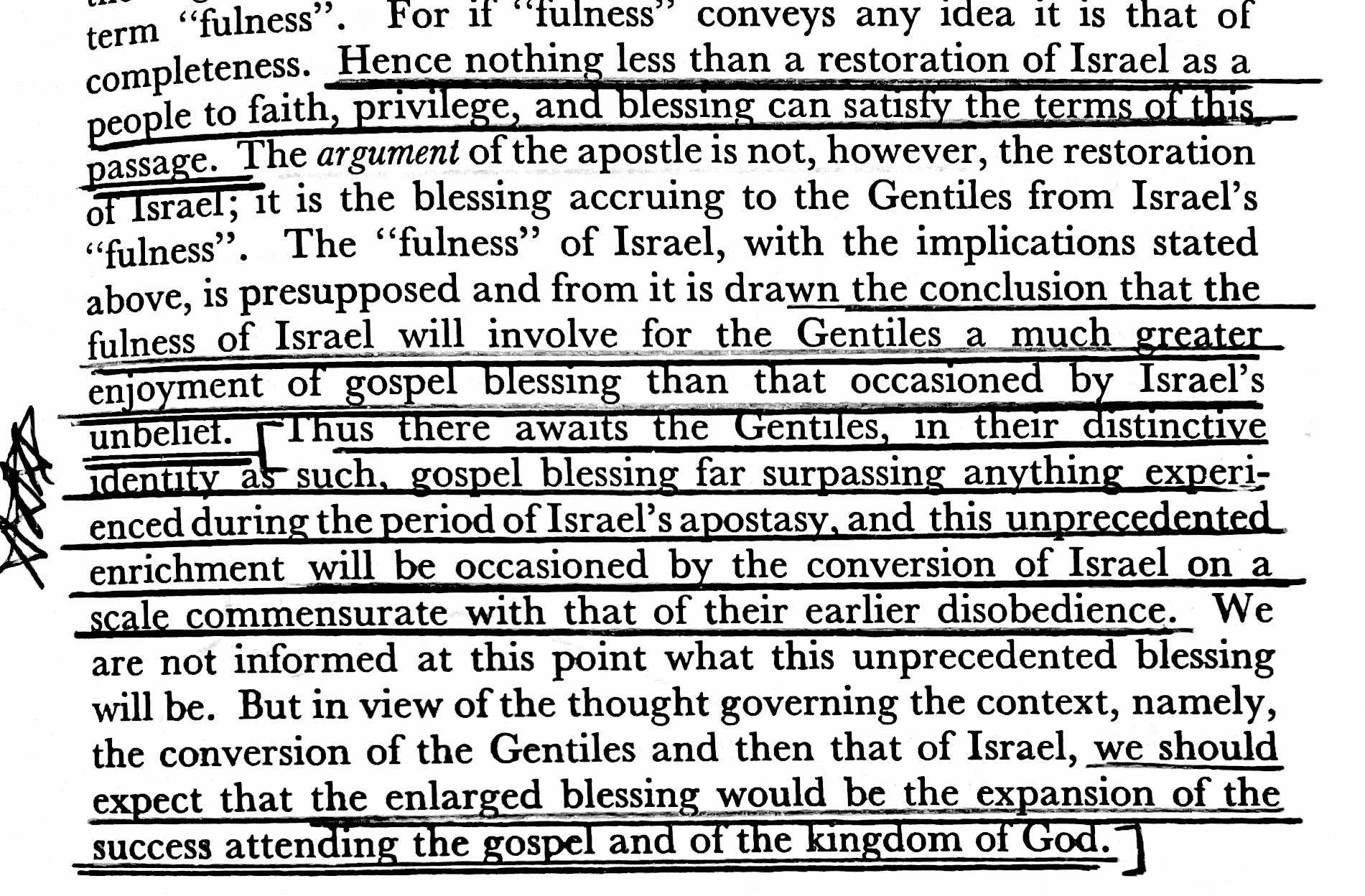
These “enlarged blessings” are part of the postmillennial vision of the Bible.
When NT writers employ the term Jews pejoratively, therefore, often they refer not to the race or even nation as such, but to a particularly rebellious subset of it. This is obvious from the truth of the Jewish remnant which the NT (as well as OT) makes abundantly clear. Since the patriarchs, ethnic Jews were a part of the covenant people of God, and will always be a part of the covenant people of God.
The Present and Future Jewish State
In his 19th century work The Restoration of the Jews, David Brown (of Jamieson, Faussett and Brown fame)2 marshals extensive biblical evidence for the restoration of ethnic Jews to the land promised the patriarchs, and this view (to which I am open, though not fully persuaded) in no way compromises the new covenant. An Israel restored to the original land of Canaan would be a believing Israel, embracing Jesus as Messiah, standing in no different relation to God the Father than their believing Gentile brothers and sisters. Whether restored to the land promised or not, ethnic Israel has a glorious future in God’s economy, not as a separate body with separate covenants and promises, but precisely in union by faith alone with the Seed of Abraham, Jesus Christ.
None of this guarantees the revival of the Jewish state, certainly not in its Christ-rejecting unbelief, and it should not dictate a single Christian viewpoint on the present state of Israel. As a classical liberal, I am broadly supportive of the existence and preservation of the present Jewish state simply because it’s an island of constitutional Western liberty within a sea of Islamic dictatorships. In addition, Israel has been a faithful friend of the United States. This is a sociopolitical view, not a specifically biblical view.
The old (Mosaic) covenant will never be revived, and attempts to do so fall under the severest condemnation, according to the book of Hebrews. David Brown himself makes clear:
Not a shred of Judaism do I expect to be restored. For no temple at Jerusalem do I look. Circumcision, priesthood, sacrifices, ritual separation and peculiarities, I hold to have been all done away in Christ, never more to be revived.3
This utterly refutes the older dispensational idea4 that God is currently operating two plans with two separate people of God, one with the Gentile church, and one with the nation Israel, both with a direct pipeline to God, the church with a pipeline via Jesus Christ, and the Jews with a pipeline via their Old Testament covenant promises and ethnicity. This is false. We are right with God in one way and one way alone: through faith in Jesus Christ (Jn. 14:6; Ac. 4:12).
Unbelieving Jews Today
What about presently unbelieving Jews? In Jerusalem Paul was hounded by the same unbelieving Jews who had followed him from place to place fulminating against him and his gospel message. When he was granted an opportunity to address the crowd under the oversight of the governing Roman authority, he began:
“I am a Jew, born in Tarsus of Cilicia, but brought up in this city, educated under Gamaliel, strictly according to the law of our fathers, being zealous for God just as you [unbelieving Jews] all are today.” (Acts 22:3, bold emphasis supplied)
Similarly, in his audience before King Agrippa defending himself against the charges of the unbelieving Jews, he declares:
“So then, all Jews know my way of life since my youth, which from the beginning was spent among my own nation and in Jerusalem, since they have known about me for a long time, if they are willing to testify, that I lived as a Pharisee according to the strictest sect of our religion. And now I am standing trial for the hope of the promise made by God to our fathers; the promise to which our twelve tribes hope to attain, as they earnestly serve God night and day” ….(Ac. 26:4–7a, bold emphasis supplied)
Finally, in Romans 11:28–29 Paul writes:
In relation to the gospel they are enemies on your account, but in relation to God’s choice they [unbelieving Jews] are beloved on account of the fathers; for the gifts and the calling of God are irrevocable. (bold emphasis supplied)
From these and similar statements, we learn a vital truth: while God is not operating two plans with two separate peoples, he does recognize two categories of unbelievers: unbelieving non-Jews and unbelieving Jews. We are only partly right to lump all unbelievers in an undifferentiated category. It is true that all stand under God’s judgment and will face a Christ-less eternity if they do not trust in him. But it is not true that there is no distinction among them. Though from the standpoint of the gospel, unbelieving Jews are our spiritual enemies, from the standpoint of God’s elective purposes, they are greatly beloved on account of the original patriarchs. In biblical eschatology, ethnic Jews enjoy glorious prospects — in their true Messiah, Jesus Christ.
Paul shares with his Christ-denying Jewish opponents belief in the true God of Israel. He breaks with them only in believing that the only way to that true God is Jesus Christ, the risen Lord. The problem is not, then, that his Jewish opponents had the wrong God and the wrong revelation, but that they approached each in the wrong way. They had a zeal for [the true] God, but not according to knowledge (Rom. 10:1–4).
John Calvin grasped the import of these texts. On Romans 11:28, he comments:
With regard indeed to the gospel, etc. He shows that the worst thing in the Jews ought not to subject them to the contempt of the Gentiles. Their chief crime was unbelief: but Paul teaches us, that they were thus blinded for a time by God’s providence, that a way to the gospel might be made for the Gentiles … and that still they were not for ever excluded from the favor of God. He then admits, that they were for the present alienated from God on account of the gospel, that thus the salvation, which at first was deposited with them, might come to the Gentiles; and yet that God was not unmindful of the covenant which he had made with their fathers, and by which he testified that according to his eternal purpose he loved that nation: and this he confirms by this remarkable declaration, — that the grace of the divine calling cannot be made void… (bold emphases supplied; I’m grateful to Steven Carr for pointing out this citation)
The Jews as an ethnic people (not believing Jewish individuals, the remnant [Rom. 11:5]) have been temporarily cut off from God’s covenant promises (vv. 17, 19–20). But God will not forsake his promises to Abraham, Isaac, Jacob, and the other patriarchs. He will one day engraft his ethnic people into the glorious covenant centered in the redemptive work of his Son Jesus Christ (vv. 22–27) that was theirs in the first place. They will join believing Gentiles, and massive numbers of both Jew and Gentile will overwhelm the earth in God’s final expansion of his splendorous gospel kingdom promises.
This is the glorious future of ethnic Israel.
Judeo-Christian? We Make Distinctions
Among a number of younger reputedly Reformed antisemites and their friends and defenders, the term today Judeo-Christian has come in for severe criticism. Jewishness has nothing whatsoever to do with Christianity and, in fact, Jews and Jewishness are its greatest enemy. They have never learned, apparently, the simple interpretive fact that the term “Jews” in the Bible, when used pejoratively, almost always denotes an unbelieving subset of ethnic Jews hostile to Yahweh (OT) or his Son Jesus (NT), not ethnic Israel as such. Therefore, they believe Judeo-Christian is a contradiction of terms.
The Reformed scholastic Francis Turretin’s Institutes of Elenctic Theology constitutes a long series of questions and elaborative answers. He will propose a theological question and then respond “We affirm” and/or “We deny” (“Elenctic” means serving to refute). Sometimes, however, Turretin adds “We make distinctions.” In other words, in some cases a simple yes or no answer just won’t suffice. Such is the case with Judeo-Christian.
If Judeo-Christian means a synthesis of Christianity and Judaism, a lowest common denominator fate that sets Jesus Christ aside, and assumes a bland monotheism and the moral principles of the Pentateuch are a sufficient basis of religious belief, then Judeo-Christian is false. There is no true religion except the Christian religion. The Jewish religion of the Old Testament era, loving and serving the true God, was the Christian religion in seed form. By contrast, the Christ-denying Judaism of Jesus’ time and as we know it is a false faith.
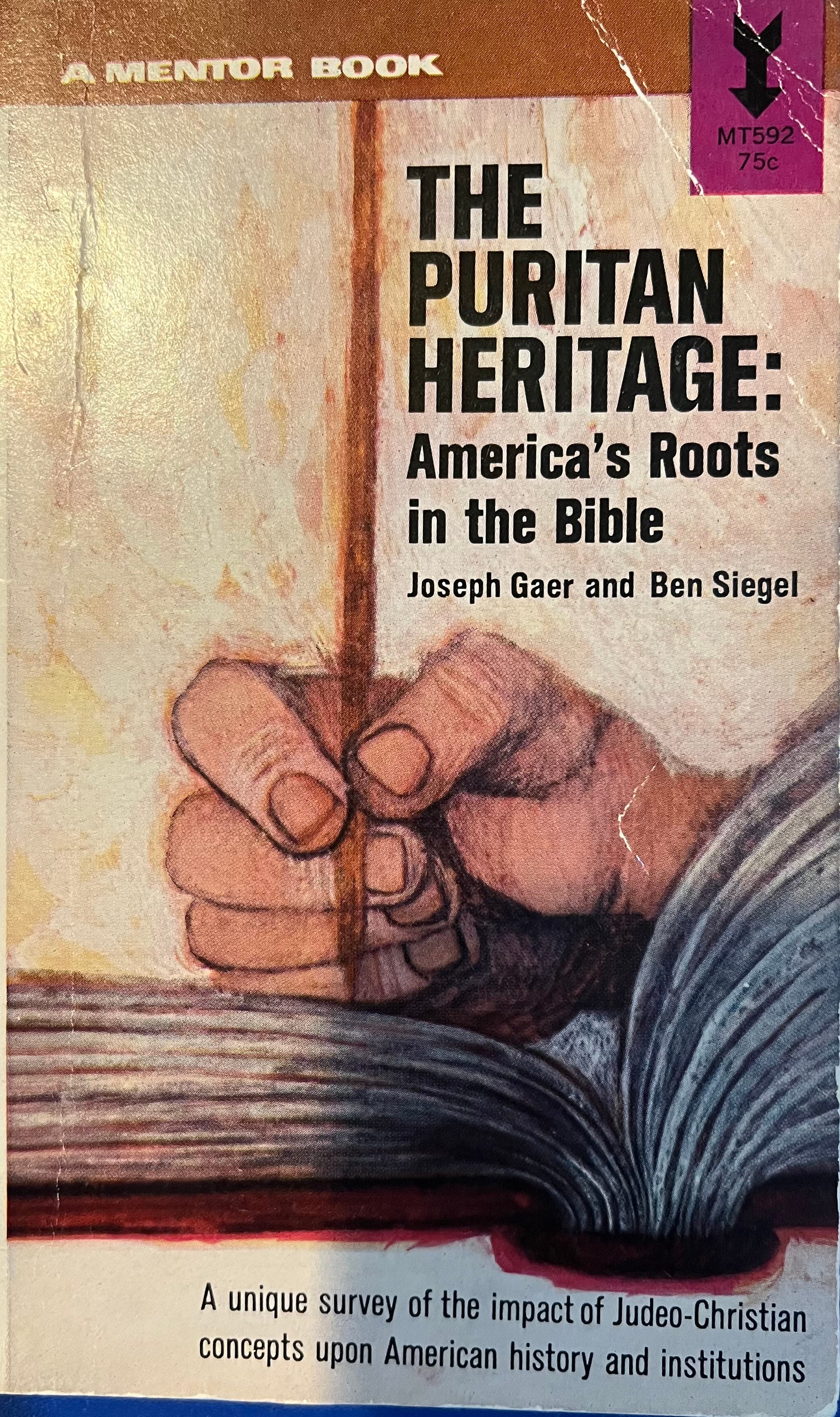
But this is not the principal denotation of Judeo-Christian. It means something more specific. It refers in most cases to a religio-cultural orientation exemplified chiefly by the United States. The New England Puritans as well as the Founders about a century and a half later both shared a very high view of Old Testament law, of “a city on a hill,” of Manifest Destiny, or economic liberty. Jews in the early American Republic were happy to support our dramatic political experiment precisely because of its Old Testament roots, and they have made valuable contributions to our nation. Today when we hear the term, we think of both Christians and Jews who have embraced strong moral principles and one God. We are opposed to moral relativism and polytheism, and Christians join Jews in the civil sphere in holding the Ten Commandments in high regard. This meaning of Judeo-Christian is entirely legitimate descriptively, even if one questions it prescriptively. Historically, the United States has been a Judeo-Christian nation.5
Replacement Theology? We Make Distinctions
Then, what about the expression, often used as an accusation, “replacement theology”? This generally means the church has replaced Israel in God’s covenant plan. If you’ve been following along this far, you’ll see how in this expression we, too, must make distinctions. What are they? The multinational and multiethnic church of Jesus Christ has replaced national Israel as the covenant people of God. But it has not replaced Jews or Jewishisness with Gentiles or Gentile-ness. The church is an expansion, and not replacement, of Jewishness.
The church is the inheritor of the Jewish covenant promises (Eph. 2:11–22). The church is the new covenant Judah and Israel (Jer. 31:31–34; cf. 2 Cor. 3:6; 1 Cor. 11:23–29; Rom. 11:25–27). The Jew-Gentile church is the Israel of God (Gal. 6:12–16). The church is the new covenant nation of Israel (1 Pet. 2:9–10). Of course, this doesn’t mean the church is a nation in the political sense in which we presently understand nations or, indeed, as ancient Israel was. The church is not a civil government. However, the church is a nation, specially chosen, elect, just as the nation of Israel was a covenant community. It is in this sense we can say that the multinational, multiethic church of Jesus Christ is the replacement of the ancient Jewish commonwealth.
But the church is not a replacement of ethic Israel, as though God is finished with his covenant promises to Abraham, Isaac, and Jacob. It is much more accurate to say that the church is the new covenant expansion of God’s covenant people, Israel, and that this expansion includes both ethnic Jews and Gentiles.
Antisemites within the church today sometimes dismiss these arguments since (they say) Jews today are not the Jews the Bible has in view. The Jews as a people considered in God’s plan were in fact abolished in A. D. 70 — Jewish Temple worship and the covenant Jewish nation were abolished in the destruction of Jerusalem. But ethnic Jews were certainly not destroyed. And since the eschatological Israel of Romans 11 hasn’t yet turned en masse to their Messiah, they certainly do exist and have existed for 2000 years as a discrete ethnic body.
Antisemitism Right and Left
Moderns tend to be alert to antisemitism on the Right more than on the Left. After all, the violent antisemitism of the 1920s–1940s in Nazi Germany and, to less extent, the Soviet Union and Fascist Italy are still fresh in our memories – at least the memories of 50+ years-olds. Leftists have persistently criticized those on the Right for antisemitic tendencies. In too many cases, the criticism has been accurate.
The Leftist furor on American campuses to Israel’s aggressive military response to Hamas’ rape and pillage of peaceful Jewish civilians just over the border from Gaza on October 7, 2023, however, refutes the commonly held myth that antisemitism exists only on the sociopolitical Right. Leftism can be just as antisemitic as the Right, and with Donald Trump’s enthusiastic pro-Israel policies, we should expect the antisemitic Left to grow even shriller.
Recent Antisemitism on the Right has emerged from a totally unexpected quarter — the youthful wing of the Reformed camp. Virulently antisemitic “ministries” like Stone Choir and its abetters and coddlers like Eric Conn, Andrew Isker, Brian Suave, and Joel Webbon relish creating or sharing antisemitic memes. They are enamored of “the Jewish Problem.” These and others provoked The Antioch Declaration, hammered out by a number of Reformed Christian leaders (I among them) and signed by hundreds, who strongly affirm the biblical worldview that includes the inescapable Jewishness of Christianity. This toleration of or muteness in the face of virulent antisemitism seems to include a suspiciously high number of professed Christian Nationalists:
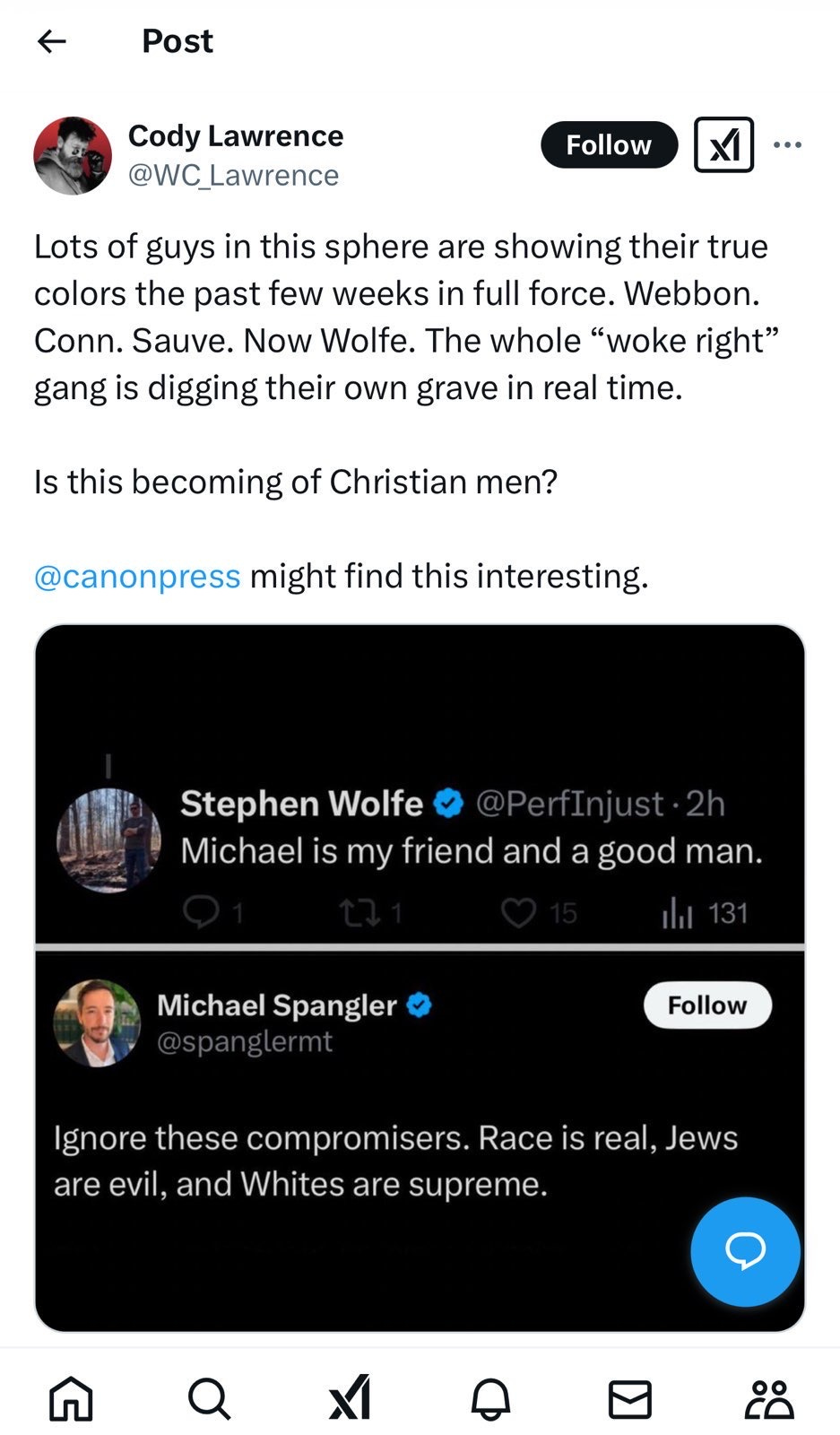

Merely following an X account does not of itself prove endorsement of the most erroneous or depraved positions championed by that account holder. When coupled, though, by crickets in the face of virulent antisemitism or even of defenses of it, the association becomes more than suspicious. If, to change the animalian metaphor, birds of a feather flock together, antisemitic bird flu is a justified diagnosis.
When race and ethnicity become an ecclesial or sociocultural criterion for Christians, they expose themselves to dire biblical warnings. Paul in Galatians levels a severe verdict on professed Christian Jews who excluded Christian Gentiles from fellowship on the ground that they were of a spiritually inferior race, and that they must become religious Jews in order to become Christians. Recent Reformed racists and their adjacent flock are guilty of a similar error, though from almost the opposite direction. In their case, it is not Jews excluding Gentiles, but Gentiles excluding Jews. A pox on both their houses.
And not a pox only. Paul delivers in Galatians his harshest verdict in all of his writings: anathema, God’s eternal judgment. Think for a moment about this. He does not deliver such an ominous judgment against the immoralists at Corinth, the schismatics at Philippi, the proto-Gnostics at Colossae, or the eschatological errorists at Thessalonica.
It’s the racists he anathematizes. As Brian G. Mattson observes, that might be sufficient reason to count unrepentant “Reformed” antisemites outside the kingdom of Jesus Christ.
Conclusion
Early Christianity sprouted from the olive tree of the Jewish covenant commonwealth. It’s unthinkable to discuss the Christian Faith apart from that context, and neither Jesus nor Paul nor any other New Testament speaker or writer ever does. God’s covenant plan is the Jewish olive tree — including both Jews and Gentiles. There is no other tree, and there is no other plan. To consistently purge Jewishness from Christianity would be to purge it of the Jewish God (the God of Abraham, Isaac and Jacob) and the Jewish Bible (the oracles of God).
Today’s antisemitism, therefore, whether in culture or church, is anti-Christian from the root up.
John Murray, The Epistle to the Romans (Grand Rapids: Eerdmans, 1959, 1965), 2:79.
Steve Schlissel and David Brown, Hal Lindsey and The Restoration of the Jews, David Brown (Edmonton, Alberta, Canada: Still Waters Revival Books, 1990), 63–190.
Ibid., 97.
I’m referring to the dispensationalism of the original Scofield Reference Bible, John Walvoord, Charles Ryrie, Dwight Pentecost and the early and mid-20th century Dallas Seminary. For the last few decades dispensationalism has creditably moved toward conventional covenant theology.
See Henry L. Feingold, “The Jewish Role in Shaping American Society,” in A Time to Speak: The Evangelical-Jewish Encounter, A. James Rudin and Marvin R. Wilson, eds. (Grand Rapids: Eerdmans, 1987), 45–57.

