

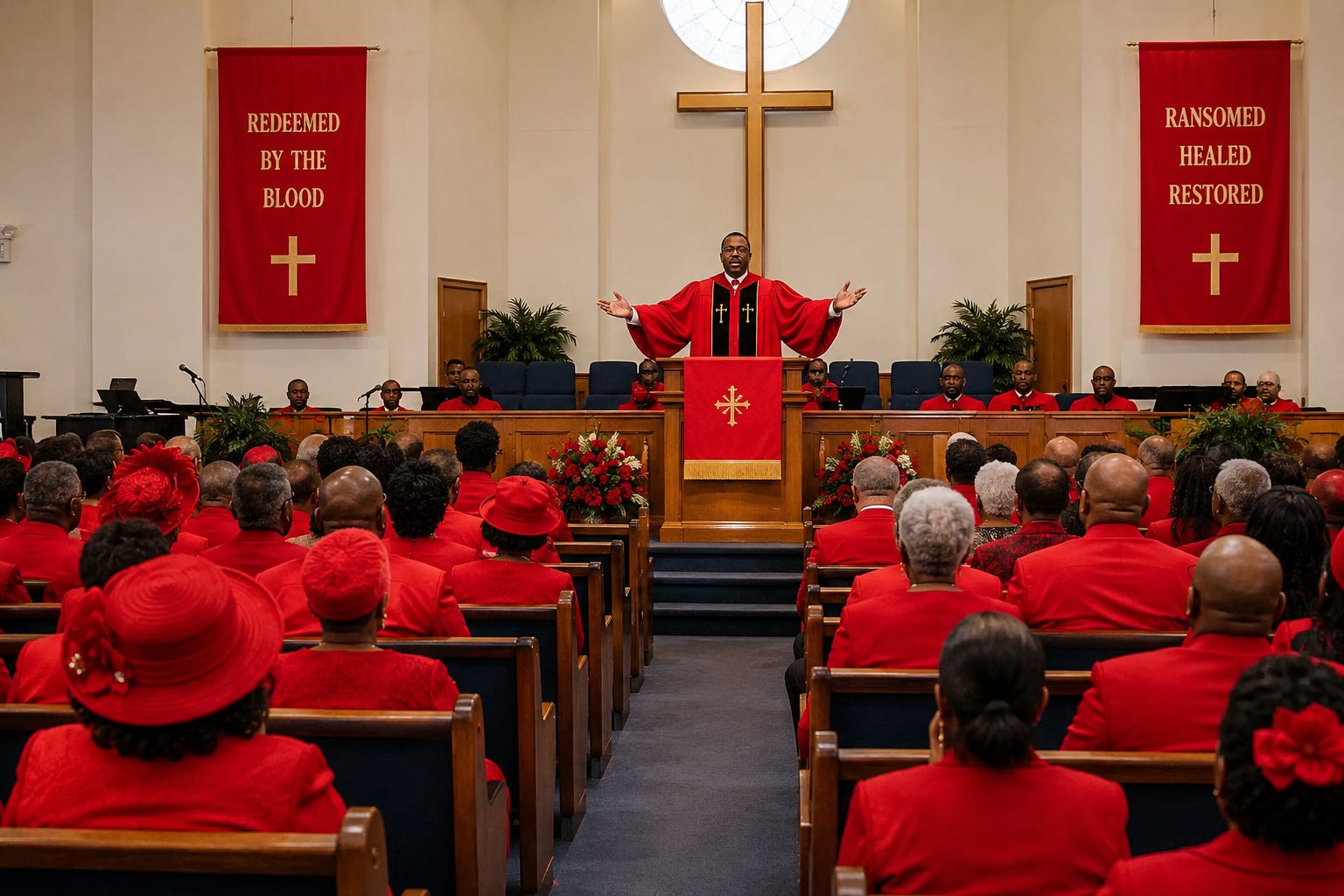
This Sunday is Pentecost Sunday, with red being the predominant liturgical color and many churches urging attendees to wear red memorializing the unique descent of the Holy Spirit fifty (“penta”) days after Passover, when Jesus had been crucified.
But why celebrate the unique descent of the Holy Spirit? A couple of reasons. First, it fulfills Jesus’ promise to his disciples that it’s necessary for him to depart so that the Holy Spirit could come, and so, further, that they could do even greater works than while he was physically present with them (Jn. 14:12–17). Jesus had warned them to wait at Jerusalem until the Holy Spirit arrived in great power by which they could effectively evangelize the world (Ac. 1:4–8). The Holy Spirit’s work in the world was not new, of course, but what was new, and what the disciples were to learn, is that there can be no world evangelization apart from the energizing power of the Holy Spirit.
Pentecost is a non-repeatable event of Christian redemptive history, and not post-redemptive history. It is no more repeatable than the death and resurrection of Christ.
This is a critical truth, because it means that if we try to evangelize our world and bring all of its cultures under the authority of King Jesus, we will fail if we neglect the work of the Spirit. Gospel preaching and biblical evangelism and cultural reclamation must always and everywhere be vitalized by the Holy Spirit. The Spirit is the divine fuel that energizes the vehicle of kingdom Christianity.
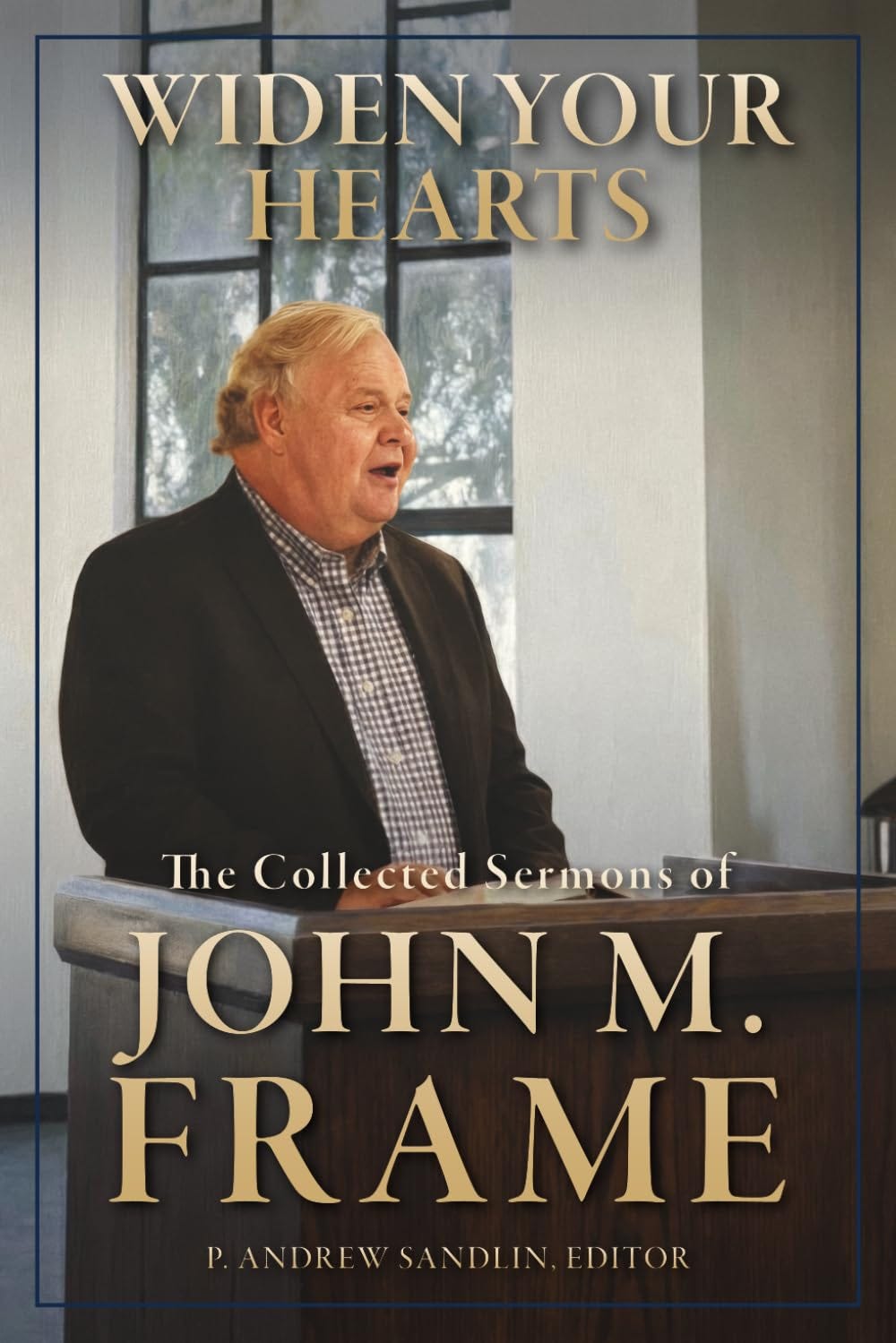
This is a collection of sermons by the preacher John Frame from the theologian John Frame. Theologians are notoriously known (often accurately) for being mediocre, boring preachers. The sermons in this book are anything but mediocre or boring. First preached in churches and conferences and from chapel platforms, the sermons are simple, direct, and hard-hitting. As the old-timers were inclined to say, John puts the cookies on the bottom shelf. Far from being an ivory-tower theological preacher, he preaches intensely relevant, practical sermons — sometimes painfully relevant and practical.
John Frame is in advancing years and suffers a few health challenges. This could be his final book. If so, there is no more appropriate capstone to, not just his academic career, but his life as a follower of Jesus Christ.
I challenge you to read these sermons from a first-rate theological mind nourished by a first-rate theological heart. I pray that God will widen your heart as a result of this reading, just as he has widened mine.
Get the hardcopy here.
Download the digital copy here.
Redemptive-Historical, Not Ecclesial-Existential
The second reason we celebrate Pentecost is because it’s a critical node on the redemptive-historical continuum. It’s surprising how many otherwise thoughtful Christians don’t know this. They understand the significance of the death, burial, and resurrection, and even ascension and second coming of Christ. But they would not include the Spirit-unleashing first post-resurrection Pentecost among these redemptive-historical events. But plainly it is. (A fine new book showing how we are inclined to misinterpret the Bible when we push its history into the background in favor of theology and experience is Mark Horne’s Blinded By the Truth: How Our Theology Obscures Biblical History.)
Most of our Pentecostal brothers and sisters and even a number of evangelicals see Pentecost much more as ecclesial-existential than redemptive-historical. What do I mean? I mean that they see it first as a pattern for the individual Christian life: the empowering of the Spirit to (for example) preach the gospel or plant churches or serve as a missionary. Even those evangelicals who do not support the Pentecostal idea of tongues in the present age consider Pentecost as offering today an ongoing “power for service,” as the early apostles experienced.
And what is true of the existential is also true of the ecclesial. Sunday worship or revival meetings often crave a 21st-century Pentecost. They long the presence and power of the Holy Spirit in the same way as the original Pentecost. Whether in a Pentecostal denomination or not, they aim to be Pentecostal churches: “Pentecost is for today.”
There’s no question we need that power and presence, but neither in our individual lives nor in our churches can we have a a scaled-down repetition of Pentecost. Nor should we. Why? Because Pentecost is a non-repeatable event of Christian redemptive (apostolic) history, and not of post-redemptive history. It is no more repeatable than the death and resurrection of Christ.
Blessing by Judgment
This is not hard to prove. Peter, when asked to explain the phenomena of Pentecost, and particularly the apostolic utterances in numerous languages of the attendees, stated they were a direct fulfillment of Joel‘s prophecy in chapter 2:28-32. There Joel is referring to the restoration of Israel, and he includes the unleashing of the Spirit in great power as accompanying this restoration. He goes on to say there will be wonders in the sky and earth, the sun turned to darkness and the moon to blood. This is not a description of the alteration of the physical heavenly bodies. Rather, this is a covenantal language metaphorically describing God’s judgment on Israel and the wider world.
This is not the way most Christians interpret Pentecost, however. Most Christians don’t recognize Pentecost was not only a Spirit-outpouring for evangelism but also for God‘s judgment. Pentecost signaled the Spirit-inaugurated last days (Ac 2:17) — not the last days of our world, but the last days of the world of covenant Israel. Peter preached with equal emphasis on the resurrection and ascension of Christ to assume his heavenly throne as the cosmic ruler of the universe. From that throne, Christ poured out the Spirit in great gospel blessing as well as great national and global judgment.
And it’s a good thing, too.
God was sending his Spirit to launch his multinational and multiethnic church after the destruction of national Israel, judgment that paved the way for getting the gospel to the world and, as a result, the subsequent destruction of the pagan Roman Empire (that’s what Revelation 17-18 is all about).
Pentecost was the non-repeatable epoch-shift from the old to the new covenant, from provincial Israel as God’s covenant people to the Jews and Gentiles everywhere as God’s covenant people — as long as they own Jesus Christ as their Lord.
Conclusion
These are two of the main staggering truths we celebrate this Pentecost Sunday: first, the arrival of the Spirit to both comfort and empower the people of God in the absence of the physical, earthly Christ, and second, God‘s judgment-coming that at one definitive, non-repeatable time paved the way for the global gospel success.
The liturgical red symbolizes the fiery power of the Holy Spirit and the tongues of fire that sat on the early Christians, in addition to God‘s judgment, as well as the martyrs’ blood. It symbolizes something very different from, let us say, a cool, icy blue would, or even the gold of royalty or the white of purity.
It symbolizes, zeal, power, and action.
In other words, Pentecost Sunday commemorates and celebrates the Spirit’s perpetual presence among his people and also his non-perpetual but once-for-all act of blessing and judgment to break the bonds of the old covenant and spread the gospel kingdom to the world.
See red this Sunday, and celebrate.✞
More great stuff
The Center for Cultural Leadership site is here.
My Amazon author page (print and digital) is here.
My I-Tunes sermons, lectures and podcasts are here.
You can find my sermons and lectures at my YouTube channel.
Sign up to get my blog updates here.
Here’s my Twitter feed.
If you want to get the free exclusive hard copy publication Christian Culture, please send me a Facebook private message.
The CCL phone number is 831-420-7230.
The mailing address is:
Center for Cultural Leadership
P. O. Box 100
Coulterville, CA 95311

