


Most alert Christians enjoy a basic grasp of Christian worldview. It has become an increasingly used expression over the last three decades. It means a view of the world shaped by Christian presuppositions; it means viewing the world through Christian spectacles. Worldviews are inescapable. Worldviews are like pancreases: everybody has one, whether he knows it or not. Much of the evil in the world is a result of alien worldviews: secular, humanist, Marxist, Islamic, pagan, materialist. The Christian worldview and the cultures it creates conflict with any attempt to implant these other pernicious worldviews.
But worldview is not enough. It is necessary, but not sufficient. An expression we hear less frequently, though it is one with historical precedent, is world-and-life view. Christianity demands not just a worldview, but also a lifeview. In fact, a lifeview is an inescapable aspect of worldview, though this fact is not emphasized much these days.
A leading reason for this omission is that the West has been heavily influenced by the ancient Greek tradition which perceives of the ordering of life as consisting of theory and practice. We think through the theoretical and grasp its meaning and plan how we should act on it, and then we put this intellectual blueprint into practice.1
We violate God‘s word when we take an objectively non-sinful action if we cannot take it in faith
The Hebraic-biblical way, by contrast, is not theory and practice, but faith and obedience. Intellectual architecture and construction never merely precede and never can be decoupled from our life’s practice. This is why Jesus said, “If anyone wills to do His [the Father’s] will, he shall know concerning the doctrine” (Jn. 7:17). We know as we obey.
The Christian LifeView is impossible apart from specific features universal to any consistently Christian life. Like these:
Heavenly Affections
We don’t hear much about religious affections these days, but the language was a staple of earlier times. Jonathan Edwards emphasized it. It refers to the affections of our heart, where heart refers to our spiritual core. Toward what is our heart gravitating? That exhibits our religious affections. A. W. Tozer once wrote, “We are becoming what we love.” Our affections determine what we are or will soon become.
When Paul said, “Set your mind [affections] on the things above, not on the things that are on earth” (Col. 3:2), he was not embracing a sort of dualistic religion, not being so heavenly minded he was of no earthly good. Far from it. Paul made very clear of what the earthly affections consisted of immorality, impurity, passion, evil desire, greed, anger, wrath, malice, slander, abusive speech, and lying (vv. 5f.). By heavenly affections, he meant a love for God and his word and his kingdom and his ways and his people. He was using alternative language to the Great Commandment to love God with all our being (Mk. 12:30-31).
A life governed by heavenly affections is a life constantly thinking about and acting on our love for him and his ways. When contemplating any action we ask ourselves: What would God desire? We must never be self-oriented or world-oriented, but only God-oriented.
This heavenly affection can never be divvied up. We may never entertain divided love and loyalty in our heavenly affections. We love God with all of our heart, and only secondarily do we love our neighbor. There is no element of our life that eludes or escapes heavenly affections. All of life is lived in the conscious presence of God and our love and loyalty for him.
This is the foundational fact of the Christian LifeView.
Faith Saturation
Paul writes in Romans 14:23 that “whatever is not from faith is sin”: whatever we do that does not proceed from Faith is sin. It’s as simple and profound as that. Paul is speaking of engaging in disputable or questionable actions. The point he’s making is that if our conscience is unclear, we had better not act. If you can’t do it in faith, don’t do it. A surprisingly high number of times in the Bible that Paul speaks of a very specific issue or controversy in a very specific context but turns it into a universal life principle. Paul could’ve said, for example, “Never violate your conscience.” He certainly meant that. But he implied that truth my making a universal statement: whatever doesn’t proceed from faith is sin.
This is such a broad life principle that it is foundational to the Christian LiveView. What specifically does it mean? It means any action that we cannot take trusting that God is behind and approves it becomes a sin, no matter how objectively sinful it might be. We already know that any action violating God‘s word is a sin, but we also violate God‘s word when we take an objectively non-sinful action if we cannot take it in faith. If we cannot launch or end a friendship, join or leave a church, partake or not partake of a particular food, engage or not engage in a particular sexual act, speak a word of encouragement or rebuke in faith – we sin when we do it.
If you’ll think about it, this must be foundational to the Christian LifeView because it covers everything we do.
We may not make artificial divisions such as: The Old Testament and the gospels are for the Jews, while Paul’s epistles are for the Gentiles. Or that all the Bible can be divided into the two parts, Gospel and Law. No.
The unbelieving world walks by sight and not by faith. It is filled with misdirection and anxiety and panic attacks because it does not make every act in faith. On our part, our salvation begins in faith. Even the ability to repent and believe must start with faith.
He who comes to God must believe that he is and that he is a rewarder of those who diligently seek him (Heb. 11:6). We must believe not only that God exists. We must, in addition, believe that the God who exists will reward those who seek after him. We know that the world and everything that we see was framed by something – Someone – that is not seen (vv. 1–4). This means our lives must be cosmically conditioned by faith.
Every decision we make must be an act of trusting God, and if we cannot trust God, we may not act. The Christian LifeView demands that we act in faith always, everywhere, in every situation.
Exceedingly Familiar
But He [Jesus] answered [Satan] and said, “It is written, ‘Man shall not live by bread alone, but by every word that proceeds from the mouth of God.’ ” (Mt. 4:4)
Our Lord’s response to Satan in the wilderness temptation makes two essential points. First, the word of God just as important to our survival as food. Second, we are to live by every word of God.
If no text in the Bible proved verbal inspiration, this one does. Verbal inspiration is the doctrine that God breathed out every word of the Bible, not just its concepts, allowing human authors to structure their own words. Every word we read in the Bible is God‘s word. And every word we read in the Bible is revealed so that we can live according to it.
So said the Lord Jesus Christ.
Coming Soon
Clearly, then, Christianity is not just a worldview but also a LifeView. We live by every word that proceeds. We don’t merely think by every word that proceeds. We can think high and lofty and sophisticated and philosophical thoughts about epistemology and ontology and deontological ethics, but unless we please God where the revelational rubber meets the situational road, we sin.
But if we are to live by every word, this means we must know every word, and this means that we must be exceedingly familiar with the Bible. Notice I did not say “substantially.” I said “exceedingly.” This means, in turn, that we must be reading it all the time. Before the closing of the biblical canon, the saints in the new covenant era were utterly reliant on the Hebrew Scriptures. Now that the canon is complete, and we have the Hebrew, Aramaic and Greek Scriptures between the covers of one book and printed widely as a result of the invention of the printing press and now digital technology, there is no reason for any Christian not to be exceedingly familiar with the Bible, familiar with every word. This doesn’t mean we need to memorize the entire Bible. It means that we must be exceedingly familiar with it and that means reading it constantly.
And since all of the Bible is the word of God, and we must live by every word, reading several sections simultaneously is almost certainly imperative. We could do worse than read concurrently from the law, the poetry, the historical and the prophetic books of the Older Testament, and the gospels and history and epistles and apocalypse of the Newer Testament.
But we may not make artificial divisions such as: The Old Testament and the gospels are for the Jews, while Paul’s epistles are for the Gentiles. Or that all the Bible can be divided into the two parts, Gospel and Law. No. There is one word, one truth, one message, one gospel, one law, and one people.
Nor must we obey the word when it speaks on churchly issues but dismiss it when it speaks on economic, technological, or political issues. We may not seek out God‘s commands on family matters but gloss over his commands on dietary, scientific, or historical matters. We live by every word, not just by our pet “spiritual” words and phrases.
The Christian Lifeview everywhere presupposes a life in submission to every single word of God.
The Christian LifeView is implied in the Christian worldview, and the Christian worldview generates the Christian LifeView. Christianity is not simply a matter of Christian thinking or even thinking about Christian thinking, but also about thinking about Christian acting — and acting.
Just as faith without works is dead, so Christian worldview without Christian LifeView is dead.✞
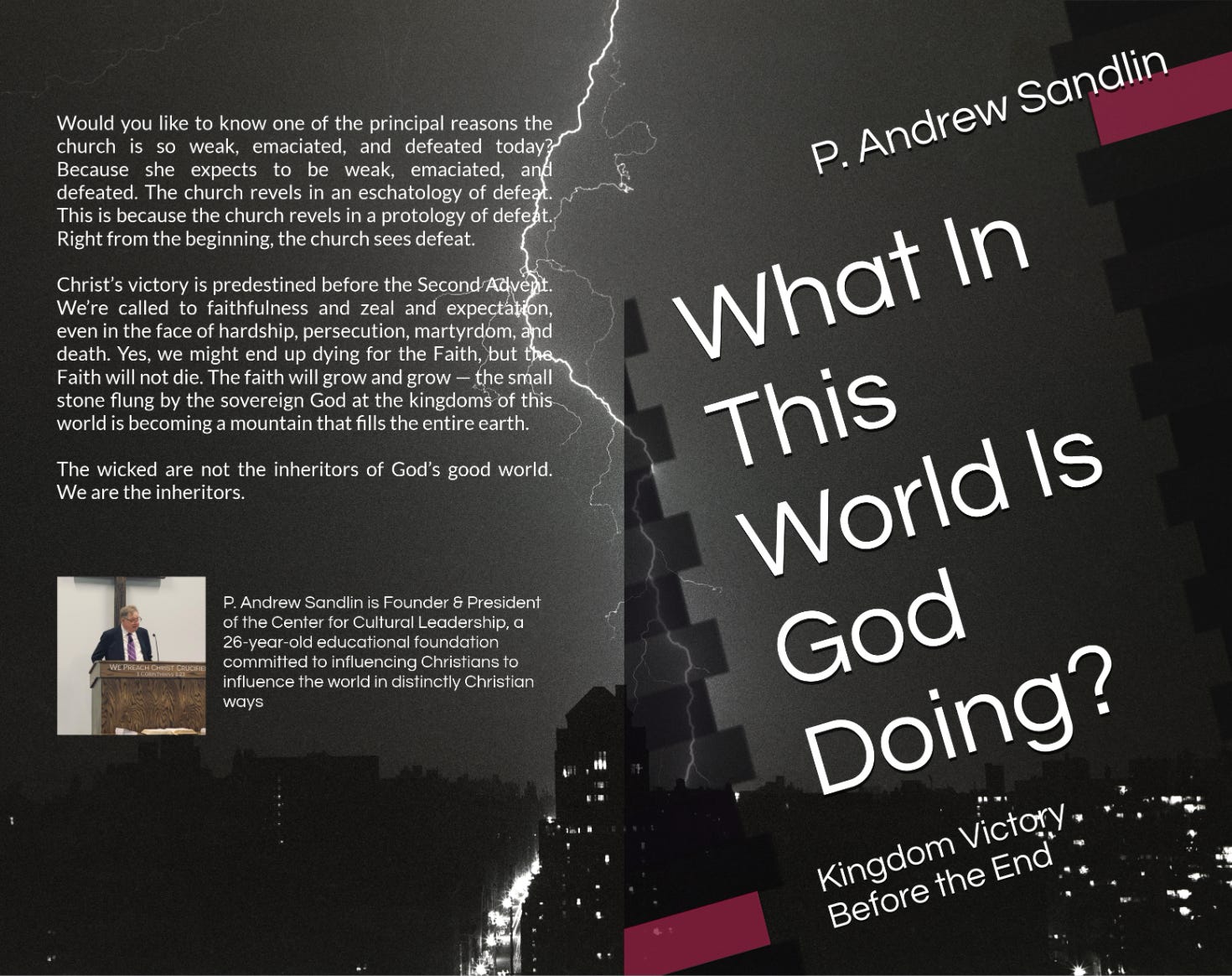
What In This World Is God Doing?
More great stuff
The Center for Cultural Leadership site is here.
My Amazon author page (print and digital) is here.
My I-Tunes sermons, lectures and podcasts are here.
You can find my sermons and lectures at my YouTube channel.
Sign up to get my blog updates here.
Here’s my Twitter feed.
If you want to get the free exclusive hard copy publication Christian Culture, please send me a Facebook private message.
The CCL phone number is 831-420-7230.
The mailing address is:
Center for Cultural Leadership
P. O. Box 100
Coulterville, CA 95311
Lesslie Newbigin, Proper Confidence (Grand Rapids: Eerdmans, 1995), 14-15.

