


Christianity pervasively influenced both the United Kingdom and the United States late into the 18th century, despite its gradual privatization. The United States broke away from the idea of a national church (the Church of England) because each of the colonies, which became states, already had their own established churches or religion (Christianity).[1] Over time, under the influence of secularism, this separation from a national church came to be interpreted secularly, as a separation from religion in general and Christianity in particular. This is what the American idea of the “separation of church and state” means today.
The United States Constitution says nothing of the kind. With the growth of secularism, “separation of church and state” came to mean that Christianity may be practiced in the individual life and the family and most of the church, but it has little or no place in the public sphere. The theology of much of evangelicalism in the 20th century implicitly assented to this divorce between public and private.[2] A reduced piety limited the Faith to otherworldly concerns, except for personal evangelism.[3] This theological approach was well suited to the strong public/private divide of American secularism.
If during Christmas you display a manger scene on a statehouse lawn, you might be violating the separation of church and state. If a Christian teacher sets a Bible or her desk in the government school, she’s unlawfully intruding religion into the public space. In social debates over same-sex “marriage,” so-called, opponents may speak of “traditional” marriage but are considered totally out of line to quote the Bible. Religion is about one’s personal life.

This was also the Marxist approach. One of its maxims was, “[R]eligion is a man’s private concern.”[4] And it has increasingly become the Western democratic approach: your religious convictions regarding human sexuality (and anything else) are fine, just as long as you keep them in church, or, more preferably, between your two ears.
Many of the most prominent, zealous evangelicals cave in to this privatization. For instance, in his book on the Puritans,[5] Martyn Lloyd-Jones, the great British evangelical, criticizes these great heroes of the faith whom he otherwise holds up as great examples. Their error? Applying the Faith in politics. Apparently, they somehow got distracted from their true calling, which is preaching an individualized soteric gospel and looking forward to the Second Coming. Lloyd Jones states that “Christian[s] must of necessity have a profoundly pessimistic view of life in this world.”[6] Our only shade of optimism is the physical return of Christ at history’s end. What this means for all of the biblical promises about gospel victory before the consummate state,[7] Lloyd-Jones does not say.
In League With the Secularists
Privatization is the intentional reduction of Christianity by Christians to the very places that secularists declare it’s safe to exist: the prayer closet, family devotions, and church on Sunday, or, at most, church social programs throughout the week. Christians come to believe that culture is inherently evil and cannot be Christianized, that the most spiritual Christians are those least engaged with the culture, that the Christian life can be exhausted by Bible reading and prayer and personal evangelism, and that anything much beyond these is “worldliness.”
Privatization, therefore, works in league with non-Christian forces to reduce Christianity to what Stephen Perks describes as a “personal worship hobby.”[8] Remarkably, many Christians and secularists agree about this privatization. Secularists say, “Christianity should stay private.” Christians respond, “We agree.” Secularists say, “Christians should stay out of politics.” Christians respond, “We agree.” Secularists say, “God’s Word has nothing to say to our society.” Christians respond, “We agree.” Secularists say, “Unbelievers should be calling all of the shots in society and culture.” Christians respond, “We agree.” Secularists say, “Christianity is a ‘private worship hobby.’” Christians respond, “We agree.” This is an odd and unsettling league in opposition to normative Christianity.
How can we envision the gradual loss of Christianity as the Faith becomes increasingly privatized? I was talking to Dr. Joseph Boot in London several years ago and he posited one plausible scenario.
Many conservative churches today refuse to address issues like socialism and abortion and same-sex “marriage” by saying they want to avoid politics. “We want to be ‘gospel-centered,’” they assert, “and we don’t want any political issues impinging on the gospel.”
But in our time, Leftists increasingly politicize all of life. Already it’s frowned on and may soon become illegal to say Jesus is the only way of salvation, to confess: “Jesus is Lord.” This, then, becomes a political issue, and not merely a so-called gospel issue. But if these churches have already surrendered vast amounts of territory to our public, politicized world, will they now draw the line at the exclusive claims of Jesus Christ? Will they finally be forced to say: “We won’t preach Jesus as the only way of salvation, because that’s a political issue?” If so, what we have is no longer Christianity.
To privatize Christianity is to destabilize, dilute, and eventually destroy it.
Creation and redemption are always both/and, never either/or.✞
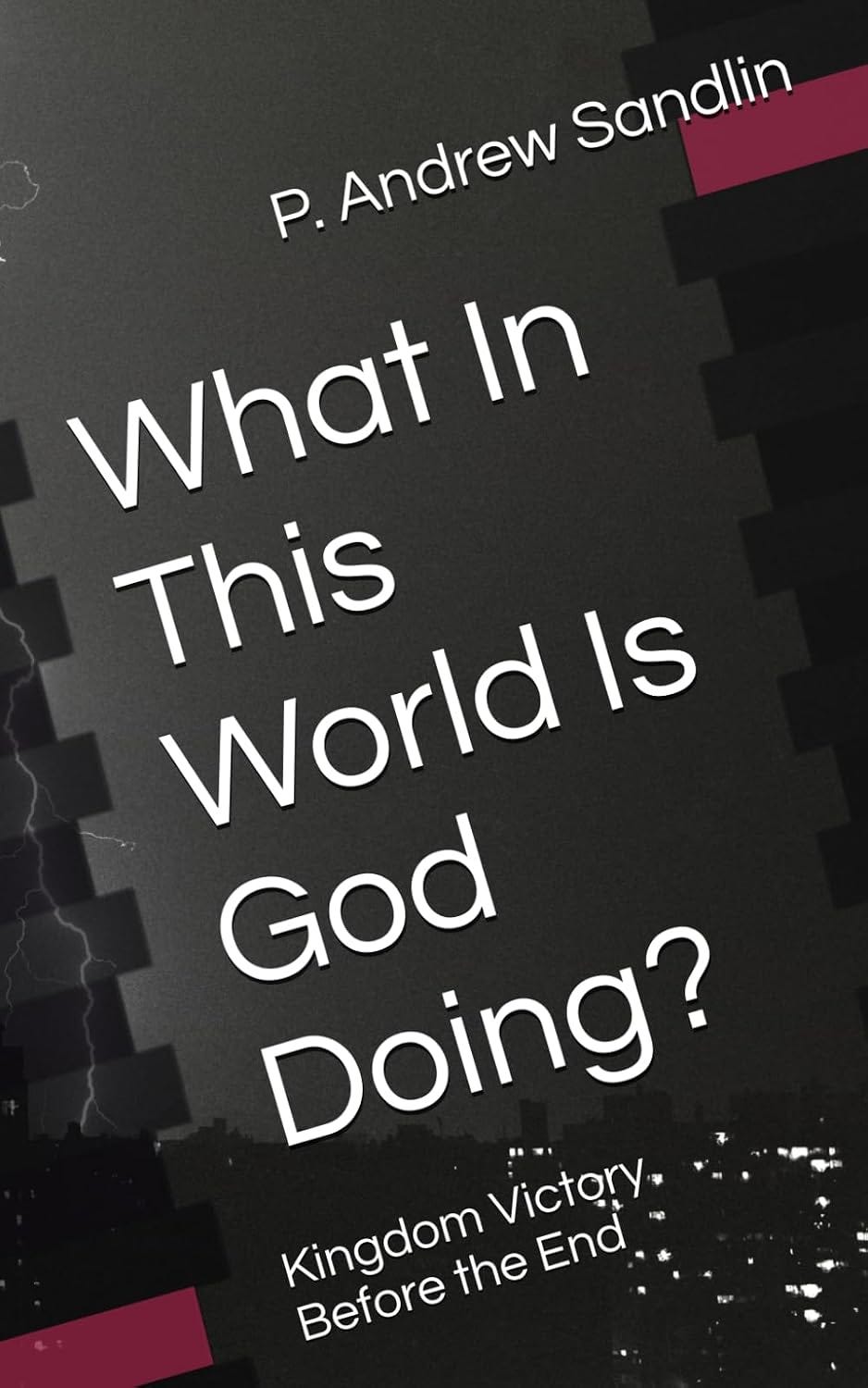
Would you like to know one of the principal reasons the church is so weak, emaciated, and defeated today? Because she expects to be weak, emaciated, and defeated. The church revels in an eschatology of defeat. This is because the church revels in a protology of defeat. Right from the beginning, the church sees defeat.
Friends, I urge you to stand on the promises of the word of God. Live in victory. We’re soldiers not just of the cross but also the resurrection. Satan’s victory is not predestined before the second advent.
Christ’s victory is predestined before the Second Advent. We’re called to faithfulness and zeal and expectation, even in the face of hardship, persecution, martyrdom, and death. Yes, we might end up dying for the Faith, but the Faith will not die. The faith will grow and grow — the small stone flung by the sovereign God at the kingdoms of this world is becoming a mountain that fills the entire earth.
The wicked are not the inheritors of God’s good world. We are the inheritors.
Get the book here.
More great stuff
The Center for Cultural Leadership site is here.
My Amazon author page (print and digital) is here.
My I-Tunes sermons, lectures and podcasts are here.
You can find my sermons and lectures at my YouTube channel.
Sign up to get my blog updates here.
Here’s my Twitter feed.
If you want to get the free exclusive hard copy publication Christian Culture, please send me a Facebook private message.
The CCL phone number is 831-420-7230.
The mailing address is:
Center for Cultural Leadership
P. O. Box 100
Coulterville, CA 95311
CultureChange is a reader-supported publication. To receive new posts and support my work, consider becoming a free or paid subscriber.
[1] M. Stanton Evans, The Theme Is Freedom (Washington, D. C.: Regnery, 1994), 270–288.
[2] See George M. Marsden, Fundamentalism and American Culture (Oxford: Oxford University Press, 1980).
[3] For an evangelical reaction, see Carl F. H. Henry, The Uneasy Conscience of Modern Fundamentalism (Grand Rapids: Eerdmans, 1947).
[4] Owen Chadwick, The Secularization of the European Mind in the 19th Century (Cambridge: Cambridge University Press, 1975), 81.
[5] D.M. Lloyd-Jones, The Puritans, Their Origins and Successors (Edinburgh: Banner of Truth Trust, 1983), 345.
[6] Ibid.
[7] John Jefferson Davis, Christ’s Victorious Kingdom (Grand Rapids: Baker, 1986).
[8] Stephen C. Perks, The Great Decommision (Taunton, England: Kuyper Foundation, 2011), 12.

