

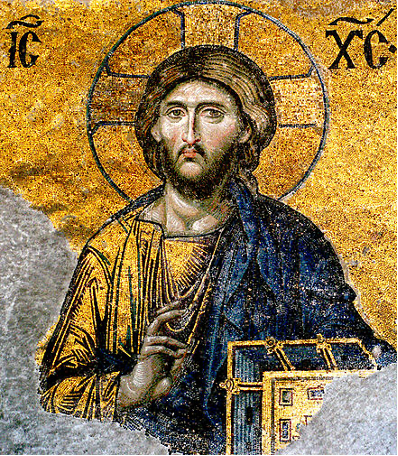
Byzantine representation of the Pantocrator
The church in its earliest days recognized Jesus Christ not just as the world’s Savior but also as its cosmic Lord — and the world’s Savior precisely because he is its Lord. He can and will save the world because he is the world’s Lord: no man, no institution, no politician can thwart his actions. Biblical texts like Revelation 1 and Daniel 7 depict Jesus in his present, resurrected, regal appearance in blazing glory, King of kings and Lord of lords. For this reason the simple expression, “Jesus is Lord” became the first creed of the church, predating even the Apostles Creed.1 Even as early as the New Testament period, Christians could boldly stand against the totalizing claims of the Roman emperor, sometimes even dying as martyrs, because they acknowledged “another king [besides Caesar], Jesus” (Ac. 17:7). A term later used to describe this sovereignty of Jesus Christ is Pantocrator, literally “ruler of all,”2 a term more prominent in the East than the West, though the idea was acknowledged everywhere. “Pantocrator” is the Greek word Paul used to describe God in 2 Corinthians 6:19 and John used it nine times in Revelation to describe Jesus: “’I am the Alpha and the Omega,’ says the Lord God, ‘who is and who was and who is to come, the Almighty [pantocrator]’” (1:8).3 As you might imagine, this conviction inspired boundless faith and confidence in the church as she fulfilled the Great Commission. This rock-solid assurance led to the Christianization of the Roman Empire. If Jesus is Pantocrator of the cosmos, there can be no impediment to the church’s earthly victory.
Ecclesiasticizing the Pantocrator
Unfortunately, over time the Pantocrator was tapered to an increasingly pagan conception of the church. Christians began to define the church according to the pattern they saw right in front them – the Roman Empire. The church as Christ’s body on earth was redefined as an institutional hierarchy, and the Pantocrator exercised rule by his earthly representative, the Pope, the ecclesiastical counterpart of the emperor.4 The Pope, the Pantocrator’s deputy and his hierarchy, ruled the church, and the church ruled the world by dragging the world into the church and its elaborate sacramental system. There was almost no understanding of reorienting the sinful world outside the church to the Pantocrator’s word, the Bible. The surrounding culture was to be subordinated to the rational ethics of pagan Greek philosophy, notably Aristotle as interpreted by the medieval theologian Thomas Aquinas. The Pantocrator was no longer the cosmic Lord but merely the churchly Lord.
War on the Pantocrator
This duality of traditional authorities — theological tradition in the church and philosophical tradition in the world — meant that vast areas of society came to neglect the Pantocrator. This created an unstable society that could not last. The adage is true: “If Jesus isn’t Lord of all, he’s not Lord at all.” The Reformation partially recovered the full-orbed biblical truth of the Pantocrator, but it also weakened the Latin church. Soon the 18th century Enlightenment eroded the Faith by introducing reason as a competing authority, and in the 19th century Romanticism added feeling and emotion as authorities. The West exiled the Pantocrator.
We live in an incontestably anti-Pantocrator world. “We do not want this man to reign over us” (Lk. 19:14) is not only a statement about Christ by the unbelieving Jews of his earthly time but also equally the sentiment of modern secular culture. No matter what their formal profession about God and Jesus may be, they are operational atheists. They deeply resent and resist the Pantocrator’s authority in their lives, especially their sexual lives. Their operative worldview is radical individual autonomy. This worldview is behind same-sex “marriage,” teenage “trans” genital mutilation, radical feminism, Andrew-Tate misogyny, intersectionality, identity politics, and vast portions of modern culture, whether Left or Right.
Conclusion
Donald Trump’s resounding election has energized many Christians. Without doubt he is preferable to Kamala Harris. To this point his executive decisions been a mixed bag of good (abolishing federal funds for minors’ genital mutilation, excluding transgendered military members, and deporting illegal alien criminals) and bad (expanding baby-killing IVF, coddling Vlad the Impaler Putin, and establishing a Federal Faith Office under the leadership of the charlatan “Pastor” Paula White). Political conservatism seems to be making a robust comeback, but Christians dare not identify a revived conservatism (which in truth is more populist than conservative) with submission to the Pantocrator. The only hope for society is Christian culture, and Christian culture is impossible apart from biblical Christianity, and biblical Christianity is impossible apart from submission to Jesus Christ. Therefore the pressing need of the hour is Christians, churches, and Christian colleges championing the authority of the Pantocrator, including the regal gospel of Jesus Christ, salvation by faith alone in him, and submission to his Lordship and his word. Anything less, no matter how superficially impressive, is a false hope and a fake cure. The Pantocrator alone is our hope. ✞
Silver Anniversary Celebration
It’s hard to believe CCL is celebrating its 25th anniversary this year. Our Silver Anniversary Celebration will be in San Francisco December 6. Because of space limitations, attendance is capped at 175. This will be a once-in-a-lifetime event. Please text Elise Kloster at 214-846-0521 to reserve your place. Interested teenagers are invited. More details later.
The End Goal of the Gospel Is Resurrection
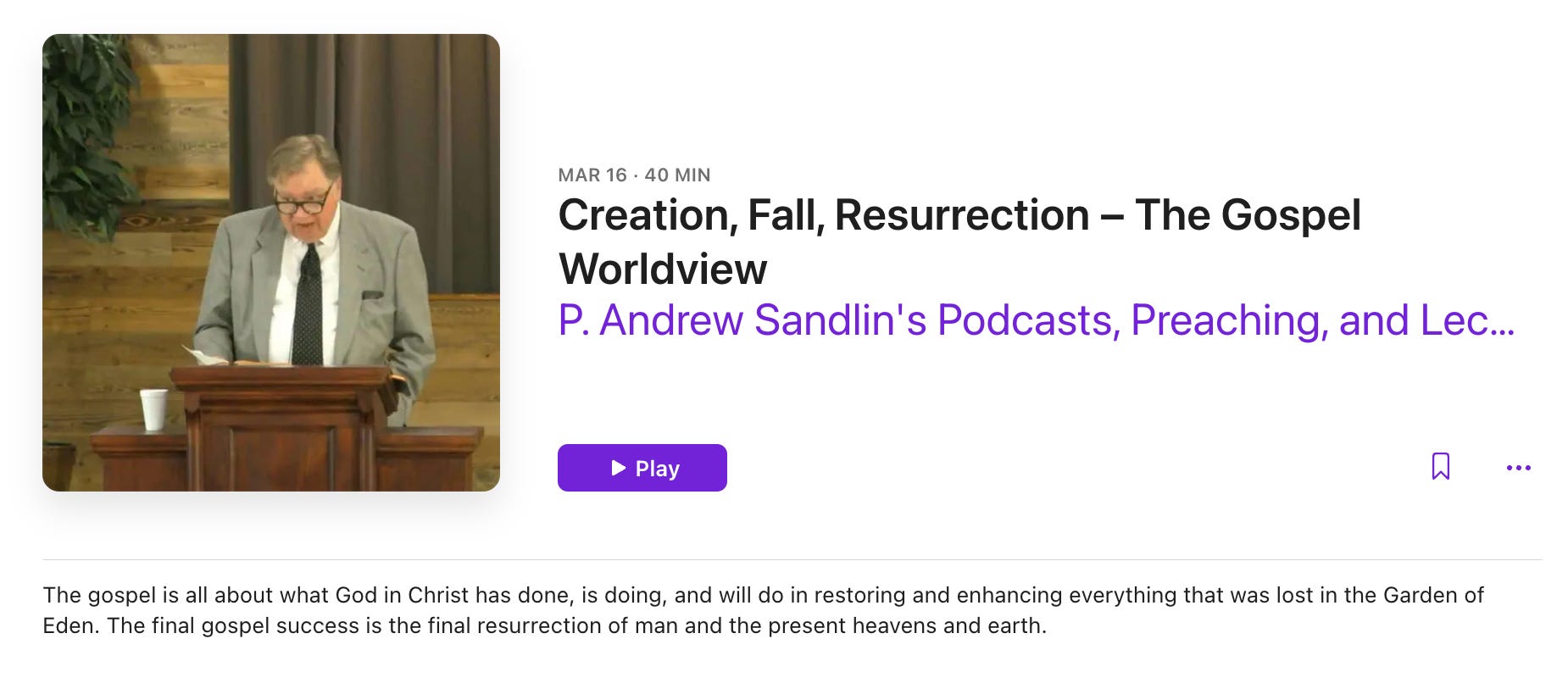
Listen here.
What Is the Biblical Approach to the Jews?
Discussion between P. Andrew Sandlin and Joe Boot.
Why Should We Pray Before Evangelism?
Even though it is crucial, prayer is often overlooked in evangelism and in the church at large. In this episode, Zack and Jake are joined by pastor and author Andrew Sandlin to discuss the critical nature of prayer in evangelism.
More great stuff
The Center for Cultural Leadership site is here.
My Amazon author page (print and digital) is here.
My I-Tunes sermons, lectures and podcasts are here.
You can find my sermons and lectures at my YouTube channel.
Sign up to get my blog updates here.
Here’s my Twitter feed.
If you want to get the free exclusive hard copy publication Christian Culture, please send me a Facebook private message.
The CCL phone number is 831-420-7230.
The mailing address is:
Center for Cultural Leadership
P. O. Box 100
Coulterville, CA 95311
Oscar Cullmann, The Earliest Christian Confessions (London: Lutterworth Press, 1949), 27–30.
Calvin G. Seerveld, Bewondering God’s Dumfounding Doings (Jordon Station, Ontario, Canada: Paideia Press, 2020), 21–25.
Kenneth L. Gentry, Jr., The Divorce of Israel (Acworth, Georgia and Vallecito, California: Tolle Lege Press and Chalcedon Foundation, 2024), 1:322.
Michael W. Kelley, The Impulse of Power (Minneapolis, Minnesota: Contra Mundum, 1998), 115–150.

